
Desk: GlobalFlow | Sovereign Risk & Cross-Border Liquidity
Publication Date: October 1, 2026
Author: The Editorial Desk, EdgeRx Media
Executive Summary
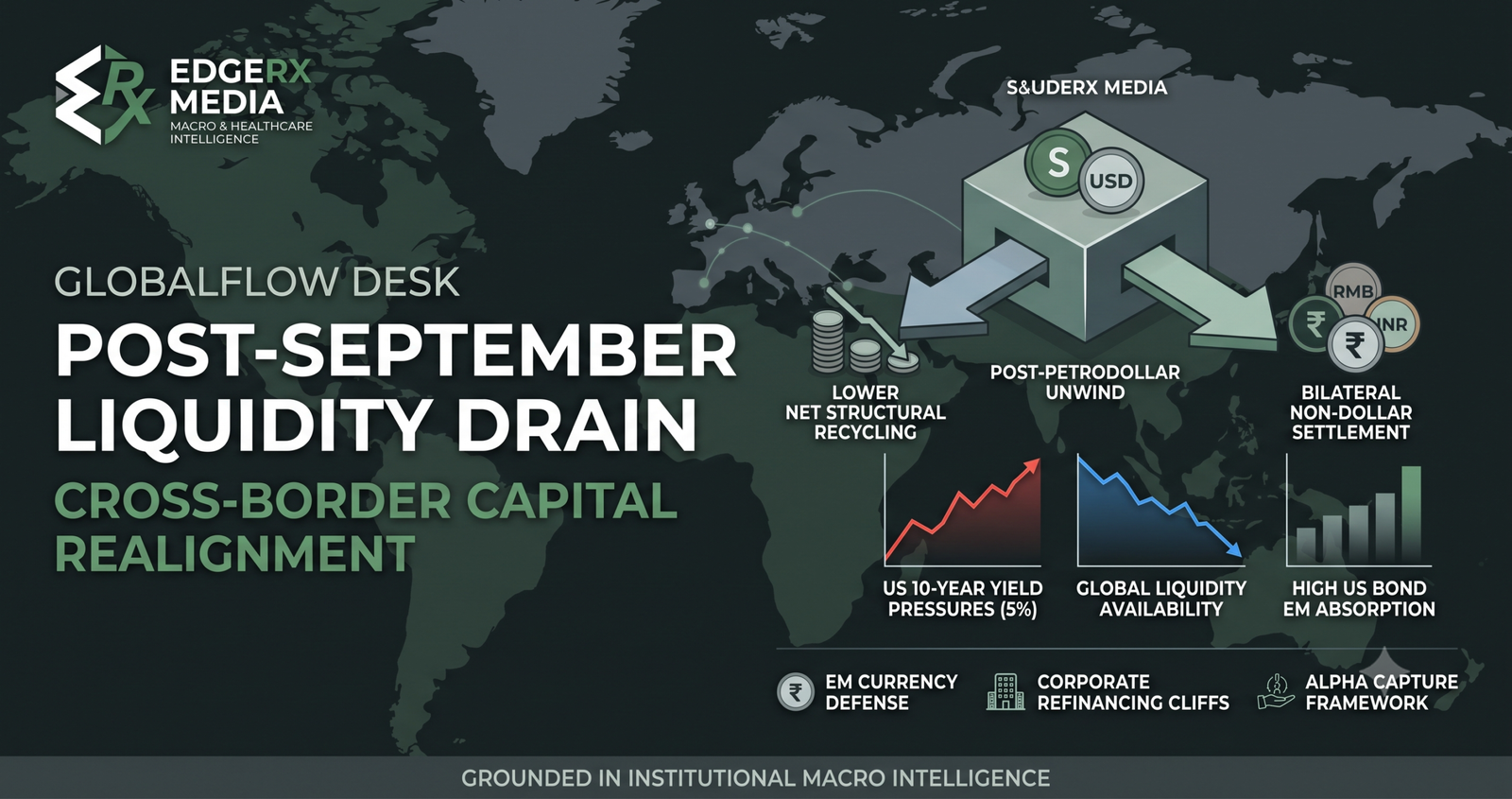
Global capital markets operate on the assumption that sovereign debt liquidity is functionally infinite and that post-WWII reserve-currency recycling mechanisms will persist indefinitely. Late September 2026 marks the operational dissolution of that assumption. Driven by the structural expiration of the historical 1974 US-Saudi petrodollar architecture, high US bond yields testing 5.00%, stagnant Indo-US trade alignments, and the industrial contraction of the Eurozone, the global cost of capital is undergoing a structural baseline repricing.
Mainstream institutional commentary characterizes current market volatility as a routine interest rate cycle driven by central bank inflation management. The empirical data reveals a systemic transition: a permanent, slow-motion liquidity drain across US sovereign debt financing, forcing cross-border balance sheets to absorb heightened funding costs, currency defense burdens, and fragmented trade settlement channels.
This briefing deconstructs the quantitative indicators of this capital realignment, details the cross-sector transmission mechanisms threatening corporate balance sheets, and provides scenario models and actionable alpha-capture frameworks for institutional capital allocators.
Tier 1: Event Profiling & Anchor Metrics
- The Triggering Catalyst: The confluence of structurally elevated US Treasury net refunding issuance alongside the quiet, non-confrontational unwinding of petrodollar recycling by Gulf sovereign energy exporters. This structural shift is accelerated by bilateral non-dollar hydrocarbon settlements across primary Asian import corridors.
- Primary Sovereign & Institutional Actors:
- The US Department of the Treasury & The Federal Reserve: Struggling to reconcile elevated deficit issuance with declining foreign official demand for longer-dated paper.
- The Saudi Central Bank (SAMA) & GCC Sovereign Wealth Funds: While Riyadh actively pilots non-dollar hydro-carbon clearing, Saudi Arabia’s strategic retention of primary reserve routing via SWIFT reaffirms that headline “petrodollar collapse” narratives are overstated. The operational friction of wholesale de-dollarization forces GCC balance sheets to prioritize domestic industrial capex while maintaining essential Western correspondent clearing rails.
- People’s Bank of China (PBOC) & Reserve Bank of India (RBI): Building decentralized bilateral currency settlement rails to insulate domestic trade from dollar clearing volatility and external liquidity shocks.
- Historical Precedent: The collapse of the Bretton Woods fixed-exchange-rate framework in 1971–1974, which forced the structural transition into the petrodollar loop, compelling global central banks to hoard US Treasuries to guarantee energy import purchasing power.
Tier 2: The Data Matrix & Quantitative Indicators
The shift in global capital architecture is visible across balance sheet metrics, auction clearing dynamics, and cross-border currency reserves:
[ GULF PETRO-SURPLUSES ] ───( Historically Recycled )───► [ US TREASURY ISSUANCE ]
            │                                                      │
            ▼ ( Post-Petrodollar Pivot )                           ▼ ( 5% Benchmark Yields )
[ BILATERAL SETTLEMENT RAILS ]                            [ CAPITAL LIQUIDITY SQUEEZE ]
 (RMB / INR / Local Corridors)                             ├── Mid-Market Refinancing Cliff
                                                           └── EM Currency Reserve Depletion
Core Macro Indicators
- US 10-Year Benchmark Yield: Persistently testing the critical 4.85%–5.05% resistance corridor. The resilience of yields at these levels indicates that high rates are driven not by transitory growth surges, but by structural issuance absorption fatigue.
- Treasury Bid-to-Cover Ratios: Progressive degradation in foreign indirect bidder participation in 10-year and 30-year sovereign auctions, requiring domestic primary dealers to absorb wider tail spreads.
- Hydrocarbon Settlement Diversification: Over 22% of total GCC crude shipments to Asian destinations clear through bilateral local currencies or non-clearing mechanisms, permanently reducing net sovereign surpluses recycled into US financial markets.
Signal-to-Noise Separation Audit
- The Noise: Financial media sensationalizes high-level bilateral diplomacy—such as Beijing’s diplomatic engagements with Washington—as an impending “reset” in trade imbalances, while simultaneously hyping Saudi non-dollar settlement pilots and the death of SWIFT. Retail markets interpret bilateral summits as a signal of easing cross-border friction and a structural turnaround for global liquidity.
- The Signal: Diplomatic visits yield political theatrics without altering balance sheet arithmetic. Neither bilateral summits nor localized currency experiments reverse the US Treasury’s record debt-issuance calendar. Capital is not fleeing the dollar; sovereign actors (including Riyadh and Beijing) continue to utilize core dollar clearing and SWIFT networks for macro stability, even while refusing to absorb long-duration paper. The structural drain on global liquidity remains entirely intact.
Tier 3: Cross-Sector Ripple Effect Analysis
The drainage of global sovereign liquidity cascades into corporate balance sheets, emerging market currencies, and strategic trade corridors:
| Economic Sector | Transmission Mechanism | Downstream Institutional Impact |
| Mid-Market Corporate Debt | Maturing low-rate debt facilities rolled over into 8.5%–11.0% credit lines | Accelerated default rates, margin contraction, and broad corporate capital expenditure freezes |
| Emerging Market Central Banks | Widening rate spreads against high-yielding US paper | Forced depletion of foreign exchange reserves to defend domestic currencies against imported inflation |
| Eurozone Industrial Corridor | High energy import costs compounded by elevated transatlantic borrowing spreads | De-industrialization, margin decay across heavy manufacturing, and capital reallocation to North America |
| Indo-US Bilateral Commerce | Unresolved bilateral trade frictions and dollar clearing volatility | Corporate treasuries forced into cross-currency hedging and increased dependence on rupee-denominated trade corridors |
Tier 4: Institutional Forecast & Paradigm Predictions
- Core Predictive Thesis: Late 2026 establishes a persistent “higher-for-longer” baseline driven by sovereign debt issuance mechanics rather than temporary consumer inflation. Institutional capital must adapt to an environment where global liquidity remains constrained, balance sheet efficiency takes precedence over growth equity, and sovereign debt carries real duration risk.
Three-Pronged Scenario Horizon
- Base Case (65% Probability): 10-Year US Treasury yields oscillate within the 4.70%–5.20% band for the next 12 to 18 months. Sovereign wealth funds continue incremental asset diversification into real infrastructure and gold. Corporate credit defaults tick higher gradually, compressing mid-market operating margins without inducing a sudden systemic banking collapse.
- Bull Case (20% Probability): Coordinated multilateral central bank interventions, combined with unexpected fiscal consolidation in Western economies, suppress sovereign yields back below 4.00%. Private credit markets normalize, providing extended runways for corporate refinancing cliffs.
- Bear Case (15% Probability): Sovereign debt auction failure or severe dealer tailing forces US Treasury yields above 5.50%. This triggers an acute emerging market balance-of-payments crisis, rapid currency devaluation across import-dependent developing nations, and sudden corporate credit freezes.
- The Black Swan Vulnerability Factor: Sudden military or cyber escalation disrupting key maritime oil chokepoints (e.g., the Strait of Hormuz or the Bab-el-Mandeb), prompting an overnight surge in crude freight rates, igniting stagflationary shocks, and paralyzing central bank monetary policy.
Tier 5: Solopreneur Strategic Verdict
- Commercial Disruption Level: Tier 2 (Systemic Re-pricing / High-Velocity Shift)The transition disrupts traditional 60/40 institutional portfolio allocations, debt underwriting standards, and international corporate treasury management.
- Premium Alpha Capture Framework:
- Treasury Duration Compression: Systematically divest from long-dated sovereign fixed income. Reallocate liquidity into 3- to 6-month ultra-short sovereign bills and physical, yield-producing infrastructure assets.
- Corporate Working Capital Fortification: Enterprises and mid-market firms must maintain a minimum of 18 to 24 months of operational runway in cash equivalents, refinancing floating-rate liabilities immediately to bypass refunding-driven spikes in base rates.
- Multi-Rail Trade Settlement: Corporate trade desks operating along the Indo-Gulf and Asian corridors must formalize non-dollar bilateral settlement options to reduce transaction friction and eliminate unilateral clearing vulnerabilities.
Primary Data Sources & References
- U.S. Department of the Treasury. (2026). Treasury International Capital (TIC) Data & Foreign Portfolio Holdings.
- Bank for International Settlements (BIS). (2026). Project mBridge Update & Cross-Border Clearing Architecture.
- International Monetary Fund (IMF). (2026). Currency Composition of Official Foreign Exchange Reserves (COFER).
- Board of Governors of the Federal Reserve System. (2026). Term Premium and Sovereign Debt Refinancing Dynamics.