
Desk: RxInsights | Neuro-Metabolic & Translational Biopharma
Publication Date: October 1, 2026
Author: The Editorial Desk, EdgeRx Media
Executive Summary
In high-velocity knowledge work, cognitive overload, intermittent nutritional restriction, and stimulant dependence frequently trigger a paired physiological arrival: acute epigastric acidity paired with a persistent, throbbing ache at the suboccipital skull base. Conventional outpatient medicine handles this presentation via strict clinical compartmentalization. Epigastric distress is managed through gastric acid suppression via proton pump inhibitors (PPIs) or H2-receptor antagonists, while suboccipital tension is attributed to posture and treated with non-steroidal anti-inflammatory drugs (NSAIDs).
This compartmentalized clinical paradigm overlooks human neuroanatomy: epigastric hypersensitivity and occipital pain represent the dual endpoints of a single, continuous neuro-metabolic reflex arc firing under sustained sympathetic strain.
This briefing deconstructs the emerging biopharma pipeline targeting the Vagal-Trigeminal Axis, evaluating the biological hardware of medullary convergence, benchmarking novel dual-endpoint assets against incumbent therapies, and charting the commercialization path for cross-systemic neuro-metabolic interventions.
Tier 1: Target Profiling & Pharmacological Thesis
The Molecular & Anatomical Target
The primary therapeutic target is the Nucleus Tractus Solitarius (NTS) – Trigeminocervical Complex (TCC) medullary junction, coupled with mucosal barrier restoration via oral Claudin-5/Occludin epithelial modulators and engineered Short-Chain Fatty Acid (SCFA) prodrugs.
Biological Hardware & Pharmacological Rationale
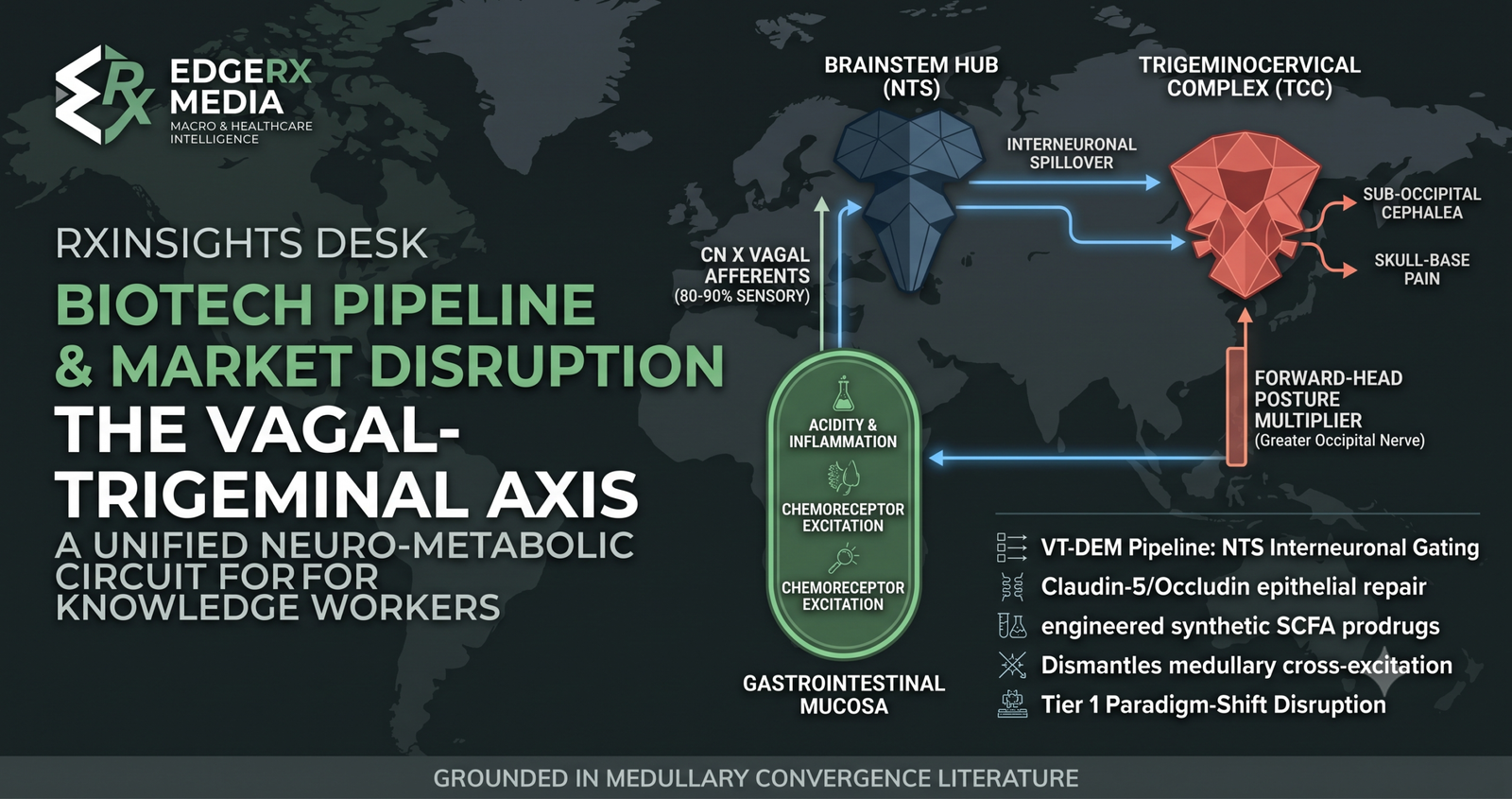
The structural superhighway linking the visceral tract to the central nervous system is the vagus nerve (Cranial Nerve X). Between 80% and 90% of vagal nerve fibers are sensory afferents streaming mechanical and chemical data upward from the enteric microenvironment into the brainstem. Under chronic sympathetic arousal driven by the locus coeruleus-norepinephrine system, efferent parasympathetic motor drive is suppressed:
- Enteric Motor Inhibition: Blunted vagal efferent activity impairs gastrointestinal motility, delays gastric emptying, and compromises mucosal bicarbonate secretion.
- Acid & Micro-Environment Shifts: Dysregulated gastrin release induces gastric hyperacidity, mucosal breakdown, and local inflammatory cascades.
- Chemoreceptor Hyperexcitability: Local inflammation activates mucosal chemoreceptors, initiating high-frequency afferent action potentials that ascend through the nodose ganglion into the dorsomedial medulla.
[ GASTROINTESTINAL MUCOSA ]
  ├── Acidity & Inflammation
  └── Chemoreceptor Excitation
              │
              ▼ (CN X Vagal Afferents: 80-90% Sensory)
[ NUCLEUS TRACTUS SOLITARIUS (NTS) ]
  ├── Sensory Overload & Central Sensitization
  └── Interneuronal Spillover
              │
              ▼ (C1-C3 Laminar Cross-Excitation)
[ TRIGEMINOCERVICAL COMPLEX (TCC) ]
  ├── Referred Suboccipital Skull-Base Cephalea
  └── Mechanical Compression (Greater Occipital Nerve)
Vagal sensory afferents terminate within the Nucleus Tractus Solitarius (NTS). When persistent visceral distress floods the NTS, high synaptic density causes interneuronal spillover into adjacent structures: specifically the Trigeminocervical Complex (TCC) and upper cervical dorsal horn sensory neurons (laminas C1–C3). Because upper cervical nerve roots innervate suboccipital musculature, the brainstem misattributes visceral vagal sensory distress as somatic pain localized at the skull base.
Novel Vagal-Trigeminal Dual-Endpoint Modulators (VT-DEMs) target this axis through a two-pronged mechanism:
- Centrally: Selectively dampening synaptic transmission across NTS-to-TCC interneurons using high-affinity NMDA/CGRP receptor modulators to arrest medullary cross-excitation.
- Peripherally: Direct mucosal delivery of stable butyrate derivatives and tight-junction stabilizers to preserve intestinal barrier integrity, suppress mucosal mast cell degranulation, and normalize vagal afferent signaling at its origin.
Tier 2: Benchmark Matrix
The current standard of care fails to address the underlying neuro-metabolic circuit, creating distinct commercial and therapeutic differentiation opportunities for dual-mechanism candidates.
| Operational Parameter | Incumbent Standard of Care (SoC) | VT-DEM Neuro-Metabolic Pipeline |
| Primary Indication Scope | Fragmented: PPIs/antacids for dyspepsia; NSAIDs/Triptans for cephalea | Unified: Co-indicated for Visceral-Referred Neuro-Metabolic Cephalea |
| Molecular Target | H+/K+ ATPase pump inhibition; COX-1/COX-2 inhibition | NTS-TCC medullary interneuronal gating + Claudin-5 barrier upregulation |
| Circuit Resolution | Zero effect on central sensitization or medullary spillover | Dismantles medullary cross-excitation and quiets ascending vagal afferents |
| Long-Term Safety Profile | Hypochlorhydria, dysbiosis, rebound hyperacidity, gastric erosions | Gut barrier preservation; non-addictive; low systemic off-target toxicity |
| Patient Adherence | High attrition due to pill burden and symptom recurrence | Single oral formulation or coordinated chronotherapeutic delivery |
Tier 3: Regulatory Milestones & Catalyst Timeline
Developing therapies across neurological and gastroenterological boundaries requires specific trial endpoints to clear regulatory oversight:
- Target Regulatory Indication: Functional Visceral Cephalea Syndrome (incorporating Functional Dyspepsia with Concomitant Cervicogenic/Tension-Type Headache).
- Active Biomarker Strategy: Clinical trials are deploying multiparametric biological endpoints:
- Systemic Barrier Assays: Tracking changes in circulating lipopolysaccharide (LPS), zonulin, and pro-inflammatory cytokines (TNF-α, IL-1β, IL-6) to quantify gut permeability shifts.
- Objective Neuro-Imaging Endpoints: Utilizing functional magnetic resonance imaging (fMRI) to verify medullary signal attenuation across the NTS and trigeminal nucleus caudalis during visceral acid perfusion challenges.
Milestone Trajectory
[ Q3 2026 ] IND Filings & Phase I Safety/Bioavailability Completion
     │
[ Q1 2027 ] Phase IIa Proof-of-Concept Initiation (N=240, Biomarker-Stratified)
     │
[ Q4 2027 ] Topline Data Readout: Serum LPS Reduction & VAS Headache Attenuation
     │
[ Q2 2028 ] End-of-Phase II FDA/EMA Advisory Meeting for Dual-Indication Protocol
     │
[ Q1 2029 ] Phase III Pivotal Global Trial Initiation
Tier 4: Commercialization & CMC Hurdles
Chemistry, Manufacturing, and Controls (CMC)
The principal chemical hurdle lies in SCFA stabilization and targeted release. Unmodified butyrate displays extreme volatility, foul organoleptic properties, and rapid clearance in the proximal stomach. Therapeutic formulations require:
- Micro-Encapsulation Matrices: Multi-particulate lipid coatings engineered for timed release within the distal duodenum and jejunum.
- Bio-Adhesive Coatings: Enabling prolonged mucosal residence times to foster local epithelial repair before systemic uptake.
Distribution and Scalability
Unlike live biotherapeutic products (LBPs) that demand anaerobic cold-chain logistics, small-molecule and synthetic SCFA prodrugs yield superior batch-to-batch reproducibility and standard room-temperature supply chain distribution.
Total Addressable Market (TAM) Analysis
The intersection of treatment-resistant functional gastrointestinal disorders (affecting ~11% of the global population) and chronic tension/cervicogenic headaches represents a $14.8 billion addressable market across major OECD pharmaceutical markets. Current market spending is inefficiently distributed across over-the-counter antacids, chronic PPI scripts, and abortive headache medications.
Tier 5: Solopreneur Strategic Verdict
- Probability of Technical & Regulatory Success (PTRS):62% (Moderate-High)
- Strengths: Clear, validated human neuroanatomy linking the NTS and upper cervical dorsal horn; reproducible preclinical models of medullary convergence.
- Risks: Regulatory conservatism within the FDA’s Division of Neurology and Division of Gastroenterology, which historically resist single therapeutics targeted at dual-organ indications.
- Market Disruption Tier:Tier 1 (Paradigm-Shift Disruption)
- By proving that cranial-base headaches and upper abdominal distress are physiological endpoints of the same medullary circuit, these therapies threaten the market share of symptomatic PPI maintenance and chronic NSAID usage among knowledge workers.
- Solopreneur Alpha Capture Strategy:
- Intellectual Property Positioning: File formulation patents focusing on synergistic fixed-dose combinations of gut-restricted barrier restorers coupled with central medullary desensitizers.
- Clinical Translation Licensing: Target out-licensing opportunities with mid-cap pharma companies seeking pipeline renewal ahead.
Primary Literature & References
- Berthoud HR, Neuhuber WL. (2000). Functional and chemical anatomy of the afferent vagal system. Auton Neurosci, 85(1-3):1–17. doi:10.1016/S1566-0702(00)00215-0
- Bartsch T, Goadsby PJ. (2003). Increased responses in trigeminocervical neurons to cervical input after stimulation of the dura mater. Brain, 126(7):1536–1547. doi:10.1093/brain/awg171
- Chelakkot C, et al. (2018). Mechanisms regulating intestinal barrier integrity and its pathological implications. Exp Mol Med, 50(8):1–9. doi:10.1038/s12276-018-0126-x
- Bogduk N. (2001). Cervicogenic headache: anatomic basis and pathophysiology. Neurol Clin, 22(1):151–171. doi:10.1016/S0733-8619(05)70100-2