
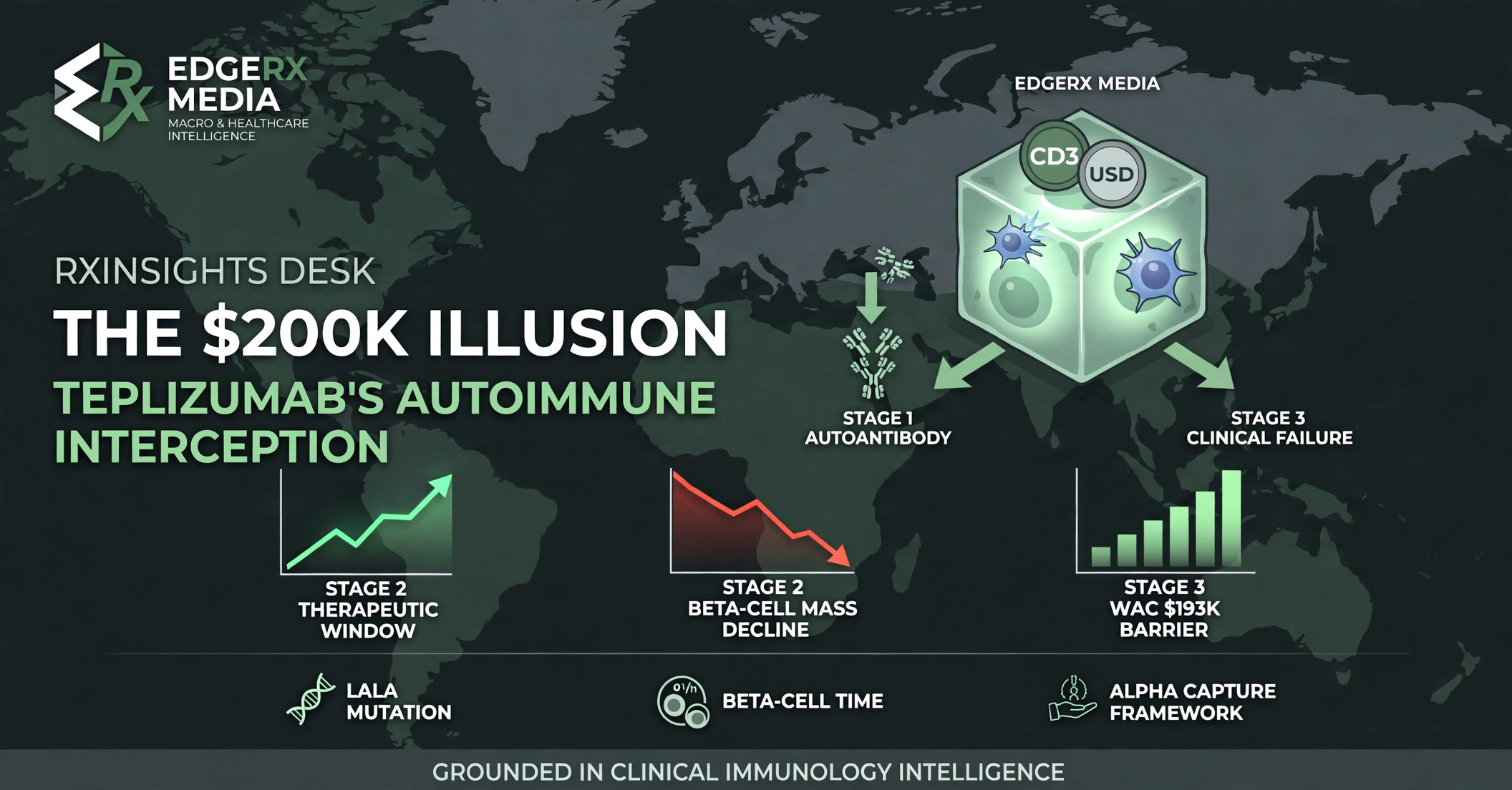
Desk: Clinical Pharmacotherapy & Immunology
Publication Date: October 28, 2026
Author: The Editorial Desk, EdgeRx Media
Executive Summary
In high-velocity pharmaceutical markets, chronic autoimmune diseases have historically been captured through downstream maintenance models, condemning patients to lifetime symptom management. Teplizumab (Tzield) dismantles this paradigm within Type 1 Diabetes (T1D). Moving the intervention window upstream to Stage 2 preclinical T1D, this anti-CD3 monoclonal antibody induces sustained immune tolerance, preserves endogenous pancreatic beta-cell function, and delays clinical disease onset. This represents a profound shift from lifelong metabolic hormone replacement to precise immunological interception.
Tier 1: Target Profiling & Pharmacological Thesis
The Molecular & Anatomical Target
The primary therapeutic target is the CD3 epsilon chain expressed on the surface of T-lymphocytes. By intercepting the immune response at the T-cell receptor complex, the therapeutic intervention prevents the autoimmune destruction of insulin-producing pancreatic beta cells.
Biological Hardware & Pharmacological Rationale
The structural superhighway driving the destruction of beta cells relies on autoreactive effector T cells. Teplizumab acts as an Fc-receptor non-activating humanized monoclonal antibody that disrupts this pathogenic cascade.
T-Cell Exhaustion & Deactivation: Binds to the CD3 receptor, inducing partial agonism that leads to anergy and apoptosis of autoreactive effector T cells.
Regulatory Immune Shift: Simultaneously expands the proportion of protective regulatory T cells (Tregs), effectively re-educating the immune system to tolerate endogenous pancreatic tissue.
Plaintext
[ IMMUNOLOGICAL SYNAPSE ]
├─ CD3 Receptor Modulation
└─ Autoreactive T-Cell Anergy
[▼ T-Cell Receptor Signal Attenuation]
├─ Downregulation of Pathogenic Effector T-Cells
└─ Upregulation of Regulatory T-Cells (Tregs)
[ ENDOGENOUS PRESERVATION ]
├─ Pancreatic Beta-Cell Survival
└─ Sustained Endogenous C-Peptide Secretion
Tier 2: Benchmark Matrix
The current standard of care addresses T1D purely as a metabolic deficit, creating distinct commercial and therapeutic differentiation opportunities for disease-modifying, immune-modulating candidates.
| Parameter | Standard of care | Tzield (teplizumab) |
|---|---|---|
| Indication | Stage 3 T1D | Stage 2 Preclinical T1D |
| Target | Metabolic tissue | CD3 receptor |
| Disease Modification | None | Delays 2-3 years |
| Administration | Lifelong injections | 14-day IV course |
| Safety | Hypoglycemia, weight gain | Lymphopenia, CRS, rash |
Tier 3: Regulatory Milestones & Catalyst Timeline
Developing therapies across immunological boundaries requires specific trial endpoints to clear regulatory oversight:
Target Regulatory Indication: Delay the onset of Stage 3 Type 1 Diabetes in adults and pediatric patients aged 8 years and older with documented Stage 2 Type 1 Diabetes.
Active Biomarker Strategy: Clinical identification relies on detecting two or more T1D-related autoantibodies (e.g., GADA, IA-2A, mIAA) coupled with dysglycemia (abnormal oral glucose tolerance test) without overt clinical symptoms.
Objective Neuro-Immune Endpoints: Utilizing C-peptide area under the curve (AUC) to objectively measure and verify sustained endogenous insulin production.
Milestone Trajectory
[ Nov 2022 ] FDA Approval secured for Tzield to delay the onset of Stage 3 T1D.
[ Mar 2023 ] Sanofi acquires Provention Bio for $2.9 billion in a strategic M&A scale-up.
[ Ongoing ] PROTECT Phase 3 trial evaluating efficacy in newly diagnosed Stage 3 clinical T1D to expand label.
Tier 4: Commercialization & CMC Hurdles
Chemistry, Manufacturing, and Controls (CMC)
As a biologic monoclonal antibody, manufacturing requires stringent mammalian cell culture systems, rigorous viral clearance steps, and strict cold-chain logistics. The therapeutic formulation is supplied as a sterile, preservative-free solution requiring careful dilution and handling prior to administration.
Distribution and Scalability
Unlike self-administered subcutaneous biologics, the administration protocol mandates 14 consecutive days of intravenous infusions in a clinical setting equipped to monitor and manage severe cytokine release syndrome (CRS) and hypersensitivity reactions. This heavy infrastructural requirement limits rapid primary care deployment and necessitates specialized infusion center networks.
Total Addressable Market (TAM) Analysis
The intersection of autoimmune interception represents a massive economic shift. While priced at roughly $193,000 for a 14-day course, the value proposition hinges on deferring the catastrophic lifetime costs of Stage 3 T1D management (insulin, CGMs, microvascular complication care). The ultimate TAM expansion relies entirely on the commercial scaling of universal autoantibody screening protocols in pediatric populations.
Tier 5: Solopreneur Strategic Verdict
Probability of Technical & Regulatory Success (PTRS): 100% [Approved]
Strengths: First-in-class FDA approval, undisputed efficacy in delaying disease onset, backed by multinational commercial infrastructure (Sanofi).
Risks: High infrastructural friction for administration (14-day IV), reliance on presymptomatic screening adoption for patient identification.
Market Disruption Tier: Tier 1 (Paradigm-Shift Disruption)
By intercepting the disease timeline before metabolic failure, this therapy threatens the long-term volume projections of traditional insulin manufacturers and CGM hardware ecosystems by fundamentally shrinking the Stage 3 patient pool.
Alpha Capture Strategy:
M&A Risk Transfer: Provention Bio executed the textbook biotech arbitrage model—securing early-stage intellectual property, absorbing the binary clinical trial risk, and selling the de-risked commercial asset to a Big Pharma incumbent capable of navigating global payer friction and market access.
Primary Literature & References
Herold, K. C., Bundy, B. N., Long, S. A., et al. (2019). An Anti-CD3 Antibody, Teplizumab, in Relatives at Risk for Type 1 Diabetes. The New England Journal of Medicine, 381(7), 603-613.
Ramos, E. L., Dayan, C. M., Chatenoud, L., et al. (2023). Teplizumab and the Role of Clinical Screening in Type 1 Diabetes. Nature Medicine.