
Desk: GlobalFlow | Sovereign Risk & Cross-Border Liquidity
Publication Date: November 1, 2026
Author: The Editorial Desk, EdgeRx Media
Executive Summary
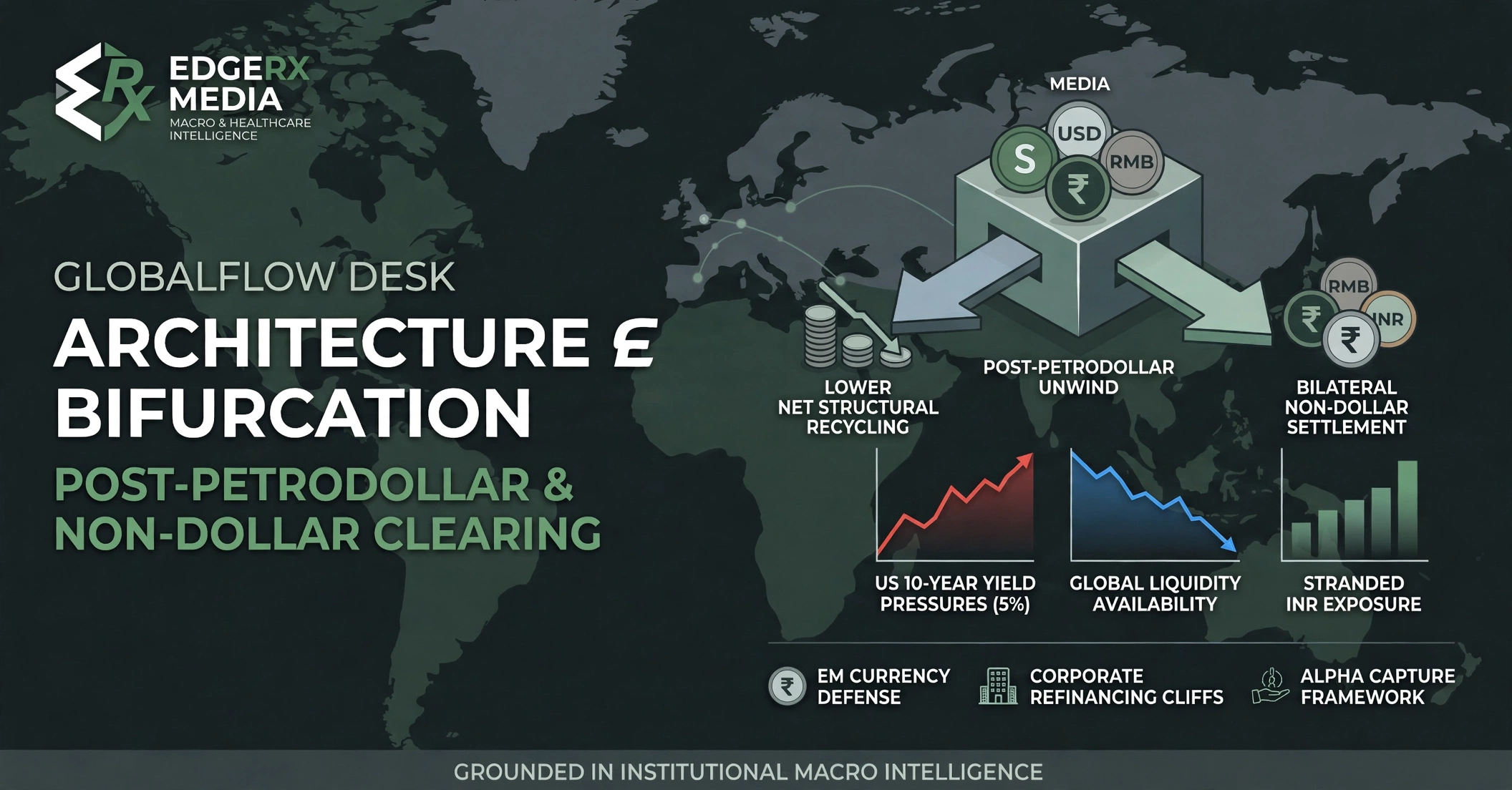
- The Structural Shift: Global cross-border settlement is shifting from centralized multilateral clearing (SWIFT/CHIPS) toward isolated bilateral currency corridors and gold-settled accounts.
- The Catalytic Mechanism: The weaponization of foreign reserve assets accelerated non-G7 sovereign risk premiums, forcing central banks to prioritize counterparty-free collateral over yield-bearing sovereign debt.
- The Emerging Friction: Bilateral local-currency trade solves external sanction exposure but introduces severe balance-of-payments imbalances and non-convertibility drag (e.g., stranded currency accumulation).
- The Strategic Outlook: The global financial architecture will not see a singular replacement for the USD; rather, it will fragment into a multi-polar, multi-currency ledger system tied to tangible commodity reserves.
Tier 1: Event Profiling & Anchor Metrics
The Triggering Catalyst: The freezing of approximately $300 billion in sovereign foreign exchange reserves in 2022 held within G7 commercial and central banking system. This broke the 40-year closed-loop petrodollar assumption: that sovereign reserves are risk-free.
Primary Sovereign & Institutional Actors: Non-G7 central banks (RBI, PBC, CBR, UAE Central Bank), Russian energy exporters, Indian commercial banks operating Vostro accounts, CIPS and domestic RTGS operators.
Historical Precedent: The collapse of the Bretton Woods fixed-exchange-rate framework in 1971-74, which forced the structural transition into the petrodollar loop, compelling global central banks to hoard US Treasuries to guarantee energy import purchasing power.
Confiscation Risk Repricing: Sovereign FX reserves held within G7 banks transitioned from risk-free baseline assets to conditional liabilities.
The Liquidity-Sovereignty Trade-off: Central banks outside Western regulatory perimeter began discounting Western debt, accepting lower transaction speed in exchange for zero jurisdictional confiscation risk.
Tier 2: The Data Matrix & Quantitative Indicators
The shift in global capital architecture is visible across balance sheet metrics, auction clearing dynamics, and cross-border currency reserves:
[ GULF / EM EXPORT SURPLUSES ] ----( Historically Recycled )----> [ US TREASURY ISSUANCE ]
| |
| v ( 5% Benchmark Yields )
v ( Post-Petrodollar Pivot ) [ CAPITAL LIQUIDITY SQUEEZE ]
[ BILATERAL SETTLEMENT RAILS ] |
(RMB / INR / AED / Local Corridors) |---- Mid-Market Refinancing Cliff
| L---- EM Currency Reserve Depletion
L---- EM Currency Reserve Depletion
|
v
[ NEUTRAL COLLATERAL LEDGER ]
(Physical Gold Delivery & Repatriation)
Core Macro Indicators
- Sovereign Reserve Repricing: Reserves transitioned to conditional liabilities.
- Central Bank Gold Accumulation: Net gold purchases sustained historically elevated quarterly rates since late 2022.
- Treasury Bid-to-Cover Degradation: Foreign indirect bidder participation degrading — signals absorption fatigue.
Signal vs Noise: Noise = “De-dollarization replacing USD.”
Signal = “Bifurcation into bilateral rails + gold as synthetic balancer.“
Benchmark Matrix: Legacy vs Fragmented Horizon
| Vector | The Legacy System (SWIFT / CHIPS) | The Fragmented Horizon (Bilateral Corridors) |
|---|---|---|
| Settlement Currency | USD / EUR dominant (>75% share) | INR, CNY, RUB, AED, local parity pairs |
| Clearing Hub | Fedwire / Clearing House Interbank (NYC) | Bilateral Central Bank Swaps / Offshore Clearing Nodes |
| Counterparty Vulnerability | Total vulnerability to secondary sanctions | Low jurisdictional legal exposure |
| Liquidity Efficiency | Deep, instant FX depth across global tiers | Fragmented, non-fungible, illiquid FX pairings |
| Capital Recycling | Deep capital markets (Treasuries, Eurobonds) | Real assets, localized sovereign bonds, physical bullion |
Tier 3: Cross-Sector Ripple Effect Analysis — The Stranded Currency Trap
The primary structural bottleneck of bilateral local-currency trading is trade balance asymmetry. Surpluses become trapped.
The Rupee-Ruble Settlement Bottleneck — Case Study
- The Asymmetry: India’s massive hydrocarbon imports created INR surplus — Russian exporters accumulated billions in INR in Indian Vostro accounts.
- The Capital Drag: Rupee capital account restrictions — balances trapped in low-yielding domestic paper.
- The Resolution Protocol: Creation of third-party clearing bridges (AED / CNY) and gold-backed equalization accounts.
| Economic Sector | Transmission Mechanism | Downstream Institutional Impact |
|---|---|---|
| Energy Export Corridor | Massive imports create INR surplus in Vostro accounts | Capital Drag: Trapped INR, forced into low-yielding domestic paper |
| Indian Commercial Banking | Capital account restrictions prevent free convertibility | Settlement Bottleneck: Requires AED/CNY bridge + gold equalization |
| Mid-Market Importers | Bilateral model destroys multilateral netting | Loss of global FX netting efficiency, increased regional FX premiums |
| EM Central Bank Reserves | Shift from Treasuries to physical bullion | De-financialization: Gold as ultimate non-sovereign bridge asset |
Central Bank Structural Re-balancing:
- Sovereign Invoicing in Local Fiat (RMB / INR / Dirham).
- Net Unbalanced Surpluses Converted at Settlement Nodes.
- Direct Physical Gold Delivery & Domestic Repatriation.
Result: De-financialization of sovereign balance sheets.
Tier 4: Institutional Forecast & Paradigm Predictions
Core Predictive Thesis: The international financial system is not heading toward displacement of the USD by a single competitor. It is bifurcating into a tri-system settlement matrix.
Three-Pronged Scenario Horizon:
- Base Case (60%): The Tri-System Settlement MatrixCore Dollar Perimeter: G7, NATO-aligned nations remain anchored to USDStrategic Bilateral Corridor: Bulk energy, raw materials trade in local currenciesNeutral Collateral Ledger: Physical bullion as final balance-of-payments resolution
- Bear Case (15%): Accelerated Fragmentation — Dual treasury rails increase working capital requirements by 15-20%
- Black Swan (<5%): Synthetic Reserve Unit — BRICS commodity-backed settlement unit achieves limited clearing-scale adoption
Tier 5: Solopreneur Strategic Verdict
Institutional capital allocators must recalibrate portfolio liquidity assumptions. Era of frictionless centralized settlement transitioning to capital fragmentation, regional FX premiums, and physical collateral backing.
- Treasury Duration Compression: Shorten USD receivable duration for export exposure. Bilateral corridors increase settlement time.
- Corporate Working Capital Policy: Price in Stranded Currency Trap — add 2-4% FX illiquidity premium or require gold/AED bridge clause.
- Multi-Rail Trade Settlement: Maintain at least two rails: Core Dollar rail for G7 + Bilateral rail (AED/INR) for strategic corridor.
- Premiere Alpha Capture Framework: Track Central Bank Gold Repatriation flows as leading indicator for EM currency reserve depletion.
Primary Data Sources & References
- US Federal Reserve — Foreign Official Holdings & Treasury Auction Data
- RBI — Vostro Account Framework & Bilateral Settlement Guidelines
- World Gold Council — Central Bank Gold Reserve Quarterly Statistics (2022-2026)
- BIS Quarterly Review — Cross-Border FX Settlement Trends